
Seasickness on the whale tours: what to expect, and how to prepare
In rough winter seas, up to a third of a boat can be sick. That is worth knowing before you book, and it is manageable if you pick the right boat and prepare.
The short answer
In rough winter seas up to a third of passengers can be seasick, even on a large catamaran, and it is usually worst while the boat drifts at the whale grounds, not during the transfer. If you are prone to it, book a catamaran rather than a RIB, take medication before departure and stay on deck with your eyes on the horizon. The heated ship of Polar Adventures and some of the catamarans list people prone to seasickness as not suitable, so check the booking page first.
See which whale tours still have places on your dates
Whale watching in the Arctic winter happens on open, sometimes rough water, and seasickness is a real feature of bad days. One February guest on a large catamaran counted “about 1/3 of the boat throwing up or with vomit bags in their hand” and still rated the trip five stars. The operator’s own listing warns about sea state. None of this should stop you; it should shape which boat you book and what you do before departure. Both are below, after the tours themselves.
The boats, from steadiest to bumpiest
Sorted by review count. Rule of thumb: the bigger the hull, the steadier the ride.
| Photo | Tour | Boat | Getting there | Duration | Price ↕ | Book |
|---|---|---|---|---|---|---|
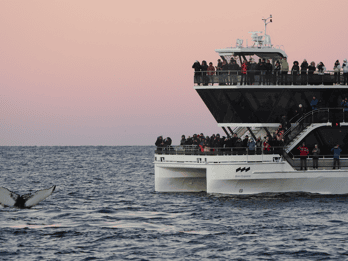
|
Whale Watching by Hybrid-Electric Boat
Brim Explorer ★ 4.5 (6,779 reviews) |
Hybrid-electric catamaran | All by boat from Tromsø | 8–9 h | €164 per person | Book now |
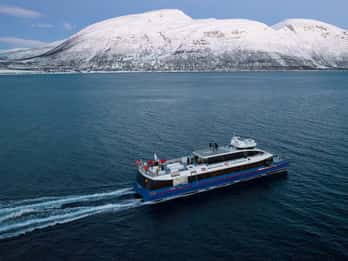
|
Whale Watching by High-Speed Catamaran
Arctic Resorts ★ 4.7 (3,747 reviews) |
High-speed catamaran | All by boat from Tromsø | 8 h · ~2.5 h with whales | €171 per person | Book now |

|
Whale & Orca All-Inclusive Cruise
Polar Adventures ★ 4.6 (1,724 reviews) |
Heated ship | All by boat from Tromsø | 8 h · departs 08:00 | €217 per person | Book now |
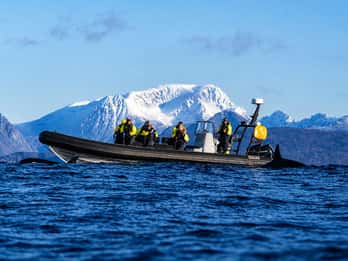
|
Skjervøy RIB Whale Safari (full day)
Arctic Adventure Tours ★ 4.8 (1,291 reviews) |
RIB (open 10-m boat) | Bus to Skjervøy, RIB from there | ~12 h · ≈3 h at sea | €308 per person | Book now |
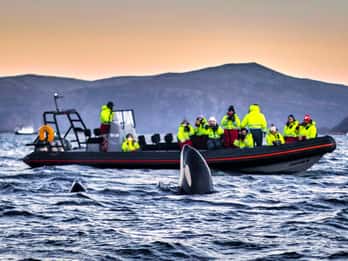
|
Magic Skjervøy RIB Whale Safari
Green Gold of Norway ★ 4.7 (1,215 reviews) |
RIB (max. 12 guests) | Bus to Skjervøy, RIB from there | ~12 h · 2.5–3 h on boat | €327 per person | Book now |
|
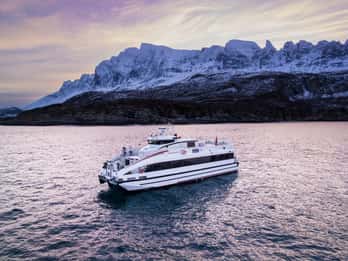
Whale Watching by Fast Catamaran from the Waterfront
Helgøy Skyssbåt ★ 4.7 (689 reviews) |
Fast catamaran (max. 90) | All by boat from Tromsø | 7.5 h | €201 per person | Book now |
|
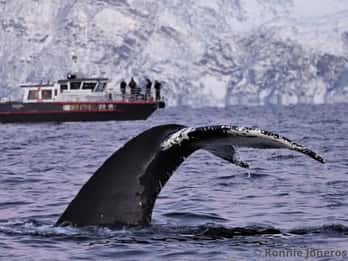
Small-Boat Whale Watching
Njord Adventures ★ 4.8 (74 reviews) |
Fast boat (max. 36) | All by boat from Tromsø | ~7 h · departs 08:30 | €226 per person | Book now |
|
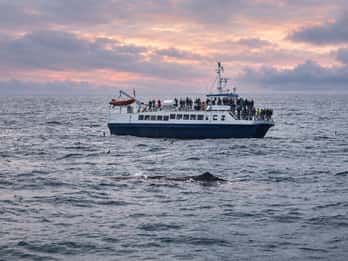
Whale Watching on the MS Alba
Arctic Whale Tours ★ 4.7 (53 reviews) |
Catamaran MS Alba | All by boat from Tromsø | ~8 h · ~2 h with whales | €155 per person | Book now |
Seat prices for each whale trip come live from GetYourGuide and include taxes and booking fees, so checkout shows the same amount.
Which part of the trip actually makes people sick
Counter-intuitively, it is usually not the fast sailing. The February guest quoted above describes it precisely: “The journey out and back in is rather smoother. However for the hour you are there whale watching it is rather bumpy.” A moving boat cuts through waves; a boat drifting or idling at the whale grounds rolls with them, and that is exactly the part of the day you came for. So the seasickness question is not “can I survive the transfer” but “how will I feel during an hour or more of drifting on open water”.
The boat-size logic
The catamarans (steadier)
- The heated ship of Polar Adventures has a warm indoor lounge, but its listing names people prone to seasickness or motion sickness as not suitable.
- The catamarans ride on two hulls and take waves more calmly than any small boat; both have heated lounges and open decks with a horizon view.
- On rough days you will still feel the drift time at the grounds. A bigger boat reduces the motion but does not remove it.
The RIBs (bumpier)
- A RIB is a small open boat that transmits every wave. One January guest called it “a thrilling version of a log flume ride”, another wrote “be prepared for the seasickness, which gets really bad when floating on the sea”.
- The upside of the same physics: fresh air and a permanent horizon view, which some prone people actually tolerate better than an indoor lounge.
- Not suitable for pregnant women or people with back problems (Arctic Adventure Tours); the ride is physical.
What actually helps
- Take seasickness medication before departure, not after the first wave. Once nausea starts, tablets struggle to catch up. Ask your pharmacist which remedy suits you, especially about drowsy vs. non-drowsy options for a full-day trip.
- Stay where you can see the horizon. On deck, midship, eyes on the horizon is the classic advice for a reason. Reading a phone screen in an indoor lounge is the opposite.
- Eat light, but eat. An empty stomach is not the hack it sounds like. Plain food before and during the trip beats both fasting and a heavy breakfast.
- Dress warm enough to stay outside. If the cold drives you into the lounge, you lose the horizon. Layers are seasickness strategy, not just comfort.
- Pick your boat realistically. If you know you are prone, book a catamaran and leave the RIB to the strong-stomached. The whales are the same.
If you are very prone to seasickness
Book one of the catamarans, medicate before departure, spend the drift time on deck watching the horizon, and check the forecast the day before. Most tours here offer free cancellation up to 24 hours before departure, so a forecast full of gale warnings does not have to become a bad memory. And remember the February guest: a third of the boat was sick, and she still called it worth it. Whales have that effect.
Guests on the rough days
The reviews this page draws on, as written.
“We enjoyed this activity … HOWEVER … about 1/3 of the boat was throwing up or had vomit bags in their hand by the end. The journey out and back in is rather smoother. However for the hour you are there whale watching it is rather bumpy. … The tour out was about 4 hours as well as the way back in and you are whale watching for an hour. For us it was worth it … but I don't think we'd do it again. … there is food for purchase on board but I recommend bringing snacks as well”
A rough-sea day. The transfer legs on the large catamaran ride comparatively smoothly. The swell is felt most during the drifting time at the whale grounds, on every boat type.
“Kind of things really depend on luck, but the view on the sea was really great. Be prepared for the seasickness, which gets really bad when floating on the sea. Anyway it's still a great adventure of life.”
“Glad I didn't get seasick 😅 We didn't see any whales but a sperm whale and the Northern Lights on the way back. The presentations … were very interesting and the food was excellent!”
Real traveller reviews from GetYourGuide.
FAQ
How likely am I to get seasick on a Tromsø whale tour?
It depends almost entirely on the day. On calm water, most people are fine on every boat type. In rough seas, up to a third of passengers can be sick even on a large catamaran, according to a February report consistent with the operator's own sea-state warning. If you are prone to motion sickness, assume the rough-day scenario and prepare for it.
Which whale tour is best if I get seasick easily?
One of the catamarans: the bigger hull rides steadier. The heated ship lists people prone to seasickness as not suitable. Avoid the RIBs: a small open boat transmits every wave, and reviewers say so bluntly. Whatever you book, take seasickness medication before departure. Two of the catamarans, Helgøy Skyssbåt and the MS Alba of Arctic Whale Tours, also list people prone to seasickness as not suitable, so read the booking page before you pick.
When during the trip is seasickness worst?
During the drifting time at the whale grounds. The transfer legs ride comparatively smoothly because a moving boat cuts through waves; a drifting boat rolls with them. Plan your deck time and your horizon-watching for exactly that phase.
What medication should I take?
That is a question for your pharmacist or doctor, not a travel site; remedies differ in strength, drowsiness and who can take them. The travel-practical part we can say: whatever you choose, take it before departure as directed, because starting after the nausea arrives rarely works.
Can the tour be cancelled if the sea is too rough?
Operators do adjust for weather. Brim Explorer, for example, converts the trip into a fjord cruise when conditions rule out the whale grounds. From your side, most tours here have free cancellation up to 24 hours before departure, so you can pull out if the forecast looks grim.
Boats from steadiest to bumpiest
Pick the boat that matches your stomach. The whales are the same from every deck.
Back to the boat comparison